

If your marketing feels harder than it used to, you’re not imagining it. Reaching your audience — really reaching them — has become more complicated, more layered, and less predictable than it was even a few years ago. The channels that once reliably drove traffic and conversions are behaving differently. And if you’ve been paying attention to search, you already know why: generative AI has fundamentally changed how people find information, and how brands get found.
However, the solution isn’t some new tool, some expensive platform overhaul, or a strategy reserved for enterprise-level marketing budgets.
It’s rooted in marketing fundamentals that have always mattered:
- Consistency
- Relevance
- Alignment
What’s changed is how we apply them, and how urgently they need to be applied across every channel your brand touches.
At Richardson Media Group, we’ve been working through this with clients across industries for the past 2+ years. What we’ve arrived at is something we call the Holistic Marketing Advantage: a new operating model for how your marketing channels work together to build visibility in an AI-driven world.
In this post, we’re walking through three practical steps to get there, along with some real-world examples of what it looks like when it’s working.
Where Search Is Right Now
To set the stage for how the rules have changed, it helps to look specifically at what’s changed in search, because search is where most of this is playing out first.
The experience of searching for something online looks very different than it did five years ago. The familiar list of ten blue links has been replaced, or at least significantly interrupted, by AI-generated answers that appear before users ever scroll to an organic result. Google’s AI Overviews synthesize information from across the web and delivers it as a direct response. AI Mode takes it further. More and more, users get what they need without clicking anything at all.
That last part is worth sitting with. 65% of searches now result in zero clicks. That means the assumption that has underpinned content strategies for over a decade (create good content, rank well, drive traffic) is no longer a reliable equation. Traffic is no longer a guaranteed byproduct of visibility. And visibility itself is no longer just about ranking.
AI-driven discovery is the new standard. Users are finding brands, answering questions, and forming impressions through AI-generated responses, not just search results pages. Which means that how AI perceives and represents your brand matters as much as — and in many cases more than — where you rank on a given keyword.
We explored this shift in depth in our first webinar on the subject. If you missed it, you can catch up here: Navigating AI-Driven Search. That conversation was about what changed in organic search. This one is about what all of those changes require from your broader marketing strategy.
The Real Problem: Siloed Marketing in a Non-Siloed World
For most organizations, marketing has been built around specialization. SEO teams optimize pages. Paid teams chase conversions and ROI. Social teams manage engagement and community. Content teams publish. Email teams nurture. Each channel has its own KPIs, its own tools, its own rhythm.
That structure made a lot of sense for a long time. Channels were more distinct. User touchpoints were fewer. Budgets were more cleanly divided. Specialization without synchronization was a reasonable tradeoff.
It isn’t anymore.
Here’s the core tension: your marketing may be siloed, but generative AI never is. When AI evaluates whether to surface your brand in an overview, cite you in a response, or associate you with a topic, it isn’t looking at your SEO performance in isolation. It isn’t evaluating your paid campaigns separately from your content. It’s reading patterns across your entire digital ecosystem all at once.
Siloed marketing doesn’t just miss opportunities in this environment. It actively sends mixed signals. And mixed signals undercut the brand authority that AI is trying to evaluate. We go deeper on this in our digital ecosystem strategy overview, worth a read if you want more context on how all of this fits together.
What Generative AI Is Actually Measuring
So what is AI actually looking for when it decides whether to surface your brand? It’s pulling from a much broader set of signals than traditional SEO ever required. Here’s what matters:
Owned Content
Your website, blog, resource library, and video content are still the foundation. But it’s not enough for this content to exist. It needs to clearly demonstrate expertise, answer real questions your audience is asking, and consistently reinforce what you want your brand to be known for.
Paid Visibility and Engagement Behavior
Paid media doesn’t directly influence organic rankings — it never really has. But it does influence what people do next. Brand awareness, return visits, and branded search volume are all engagement signals that AI factors in. Paid, deployed intentionally, can accelerate all of them.
Earned Credibility
PR mentions, backlinks, and third-party citations have always mattered for SEO authority. But the definition has expanded. A brand mention without a link, a journalist referencing your work, a podcast guest appearance; these external trust signals contribute to how AI perceives your authority in a given space.
Social Signals and Real-World Discussion
Are people talking about your brand? Engaging with your ideas? Sharing your content? Referencing you on Reddit or in community forums? User-generated content, organic conversation, and social engagement are all signals that AI uses to determine whether your brand has real-world relevance, not just digital presence.
Brand Consistency Across Every Touchpoint
This one cuts across all of the above. AI is looking for the same themes, the same messaging, the same credibility, every place your brand shows up. Inconsistency doesn’t just confuse your audience. It dilutes the signal AI is trying to read.
The bottom line: AI isn’t evaluating individual campaigns. It’s evaluating the coherence of your brand across everything.
The Holistic Marketing Advantage: A New Operating Model Based in the Fundamentals
This is where the Holistic Marketing Advantage comes in, and we want to be clear about what it is and what it isn’t.
It’s not a new tool. It’s not a new channel. It’s not something that requires starting from scratch or overhauling everything your marketing team has built. It’s a new operating model; a shift in how your existing channels relate to and reinforce one another.
The model works as a reinforcement loop:
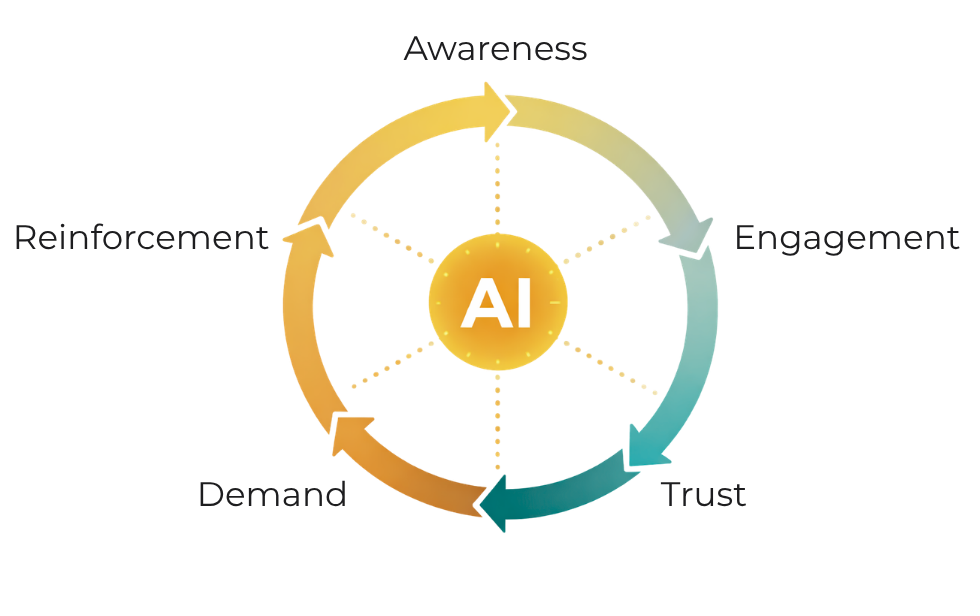
AI sits at the center of this loop, observing patterns, detecting consistency, and — when it sees enough of both, Generative AI begins to associate your brand with the topics and expertise you’ve worked to build.
The brands winning AI visibility right now aren’t necessarily doing something radically new. Many of them are doing what good marketers have always done: they know what they want to be known for, they talk about it consistently, and they show up in the places their audience is. What’s different is that the stakes of consistency have risen dramatically, and the cost of fragmentation has too.
This is fundamentally about getting back to marketing basics. Clarity of message. Consistency of voice. Alignment across touchpoints. The channel landscape has gotten more complex, but the underlying principle hasn’t changed: brands that communicate a clear, consistent identity build trust with audiences and, now, with the AI systems those audiences are using to find them.
Want to see the full presentation?
Seeing It in the Wild: Real Examples
Theory is useful. But seeing this in action makes it real. Here are two examples of brands doing this well and what we can take from them.
REI: Topical Authority and the Feedback Loop
Search for “best hiking backpack for beginners” and watch what happens. REI doesn’t just show up. They dominate: appearing across more than 20 distinct placements within a single search results page such as:
- A traditional organic listing
- An AI Overview
- A popular products carousel
- People Also Ask responses
- YouTube recommendations
- Shopping results.

This isn’t a coincidence, and it isn’t purely a function of budget. It’s the result of REI consistently doing two things exceptionally well.
First, they’ve defined a topic they want to own (gear recommendations for people who are new to outdoor recreation) and they’ve built content around it relentlessly like:
- Buying guides
- How-to articles
- Expert advice
- Product comparisons.
Not just product pages, but genuine educational content that serves a real user need. That’s Step 1 in action.
Second, that content shows up consistently across channels.
- Paid search supports organic.
- YouTube reinforces the website.
- Social content echoes the same beginner-friendly messaging.
Whether intentional or emergent, their marketing operates as a system. Google and AI don’t see REI as just a retailer. They see them as a topical authority, the go-to source on this subject. And that’s exactly the kind of brand association that drives the multi-placement dominance we see in the SERP.
Dove & Colleen Rothschild: Paid as a Lever
The second example is subtler but just as instructive.
Search for “winter skin survival guide” — an informational query with no obvious transactional intent — and you’ll find two beauty brands using paid search to surface long-form, educational content.
Colleen Rothschild is running a paid ad to their blog post on building a winter skincare routine.
Dove is promoting a guide to preventing dry skin in cold weather.
Neither ad is pushing a product purchase directly. Both are driving users to content that meets the intent of the search query, gives users a reason to stay on the site, and builds brand association with skincare expertise.

This is paid media being used as a signal accelerator, not just a demand capture tool which results in the following:
- Users who click spend time on the site, signal engagement.
- They come back, which signals brand recall.
- They start to associate these brands with expertise in winter skincare, not just with a product they saw on a shelf.
- And all of that feeds back into how AI perceives and surfaces them.
If paid advertising in your organization is currently operating exclusively in promotion mode (discount ads, sale announcements, direct response), this is an example worth studying.
What This Means for Marketing Teams in 2026
The implications of all of this are fairly straightforward, even if the execution takes work.
Channel-first strategies will continue to underperform. It’s not that individual channels don’t matter; they do, and most organizations need most of them. But a channel that operates in complete isolation from the rest of your marketing is actively undercutting the compounding effect that builds AI visibility.
Teams that collaborate will compound their results. When SEO data informs paid messaging, when social listening shapes content strategy, when email reinforces the same themes your blog is building topical authority around — marketing starts to work like an ecosystem instead of a checklist. The output is greater than the sum of its parts.
“Brands that feel "everywhere" will win. Not literally everywhere, not every platform is relevant to every brand. But when your messaging is so consistent and so coordinated that a user who finds you on Instagram, then Googles you, then sees your content referenced in an AI Overview, recognizes the same brand each time, that's the goal. That coherence is what builds trust with both audiences and AI. Marketing wins through orchestration now, not isolated channel expansion.”
Nina Gibson, Director of Search and Engagement
How to Start (Without Overhauling Everything)
This doesn’t have to be a massive restructure. It can start small. The most important thing is to start somewhere.
The single highest-leverage move you can make right now is aligning your channels around a shared set of topics: three to five things your brand genuinely wants to be known for, derived from your expertise, your value proposition, and your services.
Once those are defined, audit your existing channels and ask these two questions:
- Is everyone speaking the same language?
- Are the topics your SEO team is building content around showing up in your paid campaigns, your social posts, your email newsletters?
If there’s disconnect, that’s where to focus first. Pick one shared initiative — one topic, one campaign, one piece of content — and get every relevant channel aligned around it. See what happens. Build from there.
To help you do exactly that, we’ve put together the Holistic Marketing Advantage Playbook: a practical guide that walks through the questions to be asking your team (or your clients), the channels to audit, and the steps to take to start operating your marketing as a connected ecosystem. Download it, work through it, and reach out if you want a team in your corner to help get there.
The rules of search changed. The rules of marketing have to change with them. But the brands that will win aren’t the ones with the biggest budgets or the most channels, they’re the ones who get aligned, stay consistent, and treat their marketing as a system. That’s always been good marketing. It just matters more now.

